


Hornsby Bend
CER
The Purple Martins of Hornsby Bend


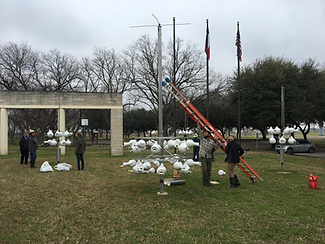
In February 2001, we hung the first plastic gourds from the light poles outside the Austin Water Center for Environmental Research. All were immediately occupied, and the Hornsby Bend purple martin colony had begun. In 2002, a 12 gourd rack was added and successfully attracted even more purple martins. In 2003, Julia and Andy Balinsky volunteered to be the stewards of the Hornsby Bend colony. They actively managed the colony through 2024 and continue to assist new volunteers. Each week during the breeding season, volunteers carefully count eggs and nestlings then record data for the Purple Martin Conservation Association. This dedicated team also cleans, repairs and takes steps to protect adults and nestlings from predators and any other threats.
The Purple Martin Girl Scout Gold Award Project
In 2025, Isaura Lopez Reed made the Hornsby Bend purple martin colony the focus of her Girl Scout Gold Award Project. Isa created a beautiful interpretive sign about purple martins and installed it next to the gourd racks outside the CER to inform visitors about the colony. She also prepared the information for this web page on purple martins.


Introduction to Purple Martins
Eastern Purple Martins (Progne subis subis) are the largest swallows in North America. These birds have a wingspan of 15 to 16 inches and a body length of about 8 inches. In the wild, the average lifespan of a Purple Martin is 5-7 years. Known for being skilled fliers and catching insects in mid-air, they also skim the surface of lakes and rivers to drink and bathe while in flight.
Adult male purple martins display shiny blue-black or purplish-blue plumage all over. Females have a grayish-brown underside and a black head, and sometimes a gray collar.


Why are they important?
Eastern Purple Martins eat large amounts of flying insects acting as a natural form of pest control for humans and the environment. They have a distinctive relationship with humans, relying entirely on human-made housing for nesting. They are also beautiful to watch, roost in large populations, and have musical songs.


Migration
Purple Martins are migratory swallows that travel between South America and North America each year. During their non-breeding season, most travel to the Amazon basin area in Brazil. Their migration route is able to cover between 5,000 and 7,000 miles. They will migrate in small groups and are one of the earliest South American migrants to arrive back at their breeding grounds in the spring. Adult males are usually the first to return north.
Here at Hornsby Bend, they may begin arriving as early as mid-January to reclaim established nesting sites. Scientists now believe that Purple Martins evolved in South America but began migrating north to take advantage of the longer summer days in higher latitudes. These long daytime hours give the birds more time to collect insects.

Breeding
As the oldest birds return to their successful nesting location from the previous year, they begin to claim best nest cavities. Males will advertise chosen spots by flying and singing to attract females. Females will choose a mate with the best nest location.
The first birds to arrive are sometimes called scouts, and are older, more experienced males. Adult females arrive soon after. Younger Purple Martins arrive about 4-8 weeks later. Nests are made out of twigs, straw, and if water is close by, mud.
While a male and female bird will stay together for the breeding season, Purple Martins do change partners each year. Males loudly sing just before daylight to attract females and other martins to the colony.
Egg Laying and Raising Chicks
Hornsby Purple Martins usually begin laying eggs in April to May. Females will lay 1 egg per day in the morning, for a total of 2-7 pure white eggs. After the next to last egg is laid, females begin incubation.
-
Only females can incubate eggs since only they have a brood patch. Males may insulate the eggs for short periods of time while the female leaves the nest. After 15-16 days, the hatching begins.
-
Newly hatched Purple Martins are born helpless (altricial), without feathers and their eyes are shut. Both parents begin to feed the chicks.
-
Pin feathers and down begin to grow and their eyes open at about 10 days old.
-
Fledging happens 26-32 days after hatching. The young receive care and training from their parents for one to two weeks after fledging.


Vocalization
Purple Martins have nine different calls and songs that they use for various purposes.
One of the most distinctive is the "dawnsong" which is heard only before sunrise at the colony.
This song is usually sung by adult males and helps attract other martins to the area.
Other vocalizations are used for things like predator alarms, leading young birds on feeding flights, begging for food, and attracting mates.

Feeding Habits
Purple Martins eat about 57 families of insects—for example: ants, wasps, dragonflies, beetles, grasshoppers, stink bugs, caterpillars, moths, butterflies, mosquitoes, flies, spiders, etc..
-
Mosquitoes make up less than 3% of their diet but they do eat a significant amount of flying fire ants.
-
They will gather insects into a ball for their youngest hatchlings.
Purple Martins depend heavily on weather conditions. Cold, wet or extremely hot conditions for more than 3 consecutive days can reduce or eliminate available food sources - insects. This can lead to starvation, especially for nestlings.


How to Attract Purple Martins
If you want to attract Purple Martins, choosing the right spot for their housing is really important. The colony should be set up about 30 to 120 feet away from human activity. They like being near people but still need some space.
Make sure the housing is also at least 40 feet away from any tall trees, since those can block their flight paths or give predators a place to hide. In southern areas, you might be able to get away with placing it a little closer to trees—about 15 to 20 feet—but open space is still best. It also helps a lot if the site is within two miles of a freshwater source like a lake, pond, or stream.
Purple Martins feed in open areas, so pick a location with plenty of space around it. Having at least one clear path for them to fly in and out makes the housing more appealing. The housing should be mounted 10 to 17 feet above the ground, and there shouldn’t be any shrubs or thick plants near the base, since those can attract predators and make them feel insecure.
Purple Martins prefer housing that is placed in open areas with clear paths for flight. Choose the center of the largest open space available, positioned approximately 30-120 feet away from human housing and at least 40-60 feet from trees. In the southern portion of their breeding range, martins may tolerate housing within 25 feet of trees, but open areas are always preferred.

Purple Martin Houses
There are two main types of Purple Martin houses: birdhouses and gourd rack systems. In southern regions of the U.S., (like here at Hornsby) most people prefer to erect light-colored (white) faux gourds.
The large white plastic gourds provide plenty of interior space and the white reflects the sun's heat to help keep nestlings cool. Gourds should be mounted at least 10–12 feet off the ground and placed on a pole outfitted with a winch and pulley system, making access easy for regular maintenance.
More information here https://www.purplemartin.org/housing/


Purple Martins and Humans through History
The creation of purple martin housing - specifically gourd racks - began when Native Americans started hollowing-out gourds to attract these voracious insect eaters. Purple Martins helped protect crops and also sounded alarms whenever predators came near.
Martins benefitted with human protection from snakes, raptors and other predators. This symbiotic relationship was later copied by European settlers who began designing multi-unit bird houses.

Conservation and Populations
Purple Martin populations have declined by about 25% (1966 - 2027) due to multiple factors; habitats in South America have been impacted by mining, cutting of native forests, fires and the changing climate. In the US, their natural nesting habitats — hollow trees in old-growth forests and open fields — have been wiped out by urbanization and logging. In addition, weather extremes like sudden cold snaps or extreme heat can impact the viability of Purple Martin populations. Purple Martins will starve if not able to catch flying insects for more than 3 days. Recently, in the spring of 2025, at Hornsby Bend several posts holding purple martin homes were impacted by 70 per mile winds, while recent freezes have impacted Purple Martin local populations.
Predators such as cats, snakes, owls, racoons and raptures prey on eggs and nestlings while introduced/invasive bird species (European starlings and sparrows) compete for nest cavities. “Landlords” that help protect purple martins must check constantly to assure that especially sparrows don’t take over purple martin nests, or purple martins are not killed by starlings.
Purple Matins need your help!
Urban and suburban tree roosts are sometimes seen as a nuisance to owners of private property. To ensure their survival, Martin roosts need recognition and protection. Some things you can do to help:
-
Put up a purple martin house and/or gourd rack on your property, place of business or in a local park, school or community center.
-
Be an active manager of your purple martin colony.
-
Keep your cat indoors. Free-roaming cats eat birds and other wildlife.
-
Visit a Purple Martin roost party (July-August) organized by Travis Audubon. Bring your family, friends, neighbors and co-workers to experience the spectacle too.
-
Become a volunteer at Hornsby Bend and help clean, count, and manage the roosts - contact Travis Audubon
-
Participate in Hornsby Bend activities like bird counts, cleanups and educational opportunities
-
Take a class with Travis Audubon to learn more about Purple Martins.
Martin Roosts and Purple Martin Parties
Martins are very social. After chicks fledge, they move from their nesting colony to large, communal roosts before migrating to South America.
One of the largest Purple Martin roosts can be experienced each year by attending one of Travis Audubon’s Purple Martin Parties.



Purple Martins and Youth
Youth organizations can play a special role in helping to protect purple martins. From girl scout silver or gold projects, boy scout eagle or service projects, to other youth organizations and school groups, there are multiple ways to earn badges, journeys and awards that involve birding and purple martins. Schools can also sponsor and install purple mountain houses or host learning sessions.
Girl Scouts from Troop 1387 learn about Purple Martins and count hatchlings at Hornsby Bend.


Austin Youth River Watch students help maintain the Hornsby Bend Purple Martin colony


Other Resources
Travis Audubon Society website Travis Audubon – Inspiring Conservation Through Birding
Purple Martin Conservation Association website - https://purplemartin.org
Purple Martin Basics - https://www.purplemartin.org/purplemartinbasics/
Purple Martin Goes Urban website - https://heathervaley.net/purple-martins
The Purple Martin and Its Management in Texas (Texas Parks and Wildlife Department guide) https://tpwd.texas.gov/publications/pwdpubs/media/pwd_bk_w7000_0254.pdf
National Wildlife Magazine 2024 article
about the Hornsby Bend Purple Martin Colony
Making Room for Purple Martins on Public Property
The Purple Martin, Robin W. Doughy and Rob Fergus (2002)
Description: Robin Doughty and Rob Fergus here present a concise natural history of the bird and its centuries-long companionship with people. They discuss the martin's scientific classification and names, its migration and range, and its family life. They relate stories of how Native Americans and European colonists attracted Purple Martins and how Americans throughout the nineteenth and twentieth centuries helped martins survive the loss of natural nesting sites by providing houses for them.
(Doughty and Fergus are University of Texas Geographers who also helped start the Hornsby Bend Purple Martin Colony and the Hornsby Bend Bird Observatory Program)

